FFoundationalActive Directory
Active Directory Certificate Services
Understand what AD CS is, why organizations deploy it, and why its integration with Active Directory identity makes it one of the most consequential, and most commonly misconfigured, components in enterprise Windows environments.
Hook
A certificate can authenticate to Active Directory as anyone the domain trusts, including a full domain administrator, without a password ever being guessed, cracked, or stolen. That capability is not a bug: it runs by design in a large share of enterprise Active Directory environments today, sitting inside a Windows Server role most IT teams installed years ago and have not revisited since. Nobody has to breach the certificate authority to get one of these certificates. They just need to find one that is set up to hand it over.
Predict
What would have to be true about a certificate, and about the person requesting it, for that certificate to work as a domain administrator's credential?
Why it matters
AD CS matters because it connects two domains that many defenders think about separately: certificate management and identity management. When AD CS issues a certificate with authentication-capable properties, that certificate becomes a credential, functionally equivalent to a password or a Kerberos ticket. Unlike passwords, certificates can be valid for years, are not affected by password rotation policies, and are often harder to revoke effectively.
For attackers, a misconfigured AD CS deployment is one of the most reliable paths to privilege escalation and persistence in Active Directory. For defenders, understanding AD CS is essential because its misconfigurations do not look like traditional vulnerabilities; they look like configuration choices that happen to have dangerous consequences.
Key Concepts
- Internal PKI — AD CS is a Windows Server role that establishes an internal Public Key Infrastructure, allowing the organization to issue and manage its own certificates without an external certificate authority
- Enterprise CA integration — an Enterprise CA integrates directly with Active Directory, using AD for certificate template storage, enrollment permissions, and trust distribution, which is why misconfiguration has domain-wide impact
- Certificate templates — templates define what properties a certificate will have and who can request it; they are the primary configuration surface and the primary attack surface in AD CS
- Authentication via PKINIT — certificates issued by AD CS can be used for Kerberos authentication, which means a certificate can function as a credential, not just an encryption tool
- NTAuthCertificates — this AD object defines which CAs are trusted for authentication; if a CA is listed here, certificates it issues can be used to prove identity to the domain
Theory
Core idea
Active Directory Certificate Services is a Windows Server role that gives an organization its own internal certificate authority: the ability to issue, manage, and validate digital certificates without relying on an external provider. What makes AD CS significant is not that it manages certificates, but that it ties certificate trust directly to Active Directory identity. A certificate issued by an AD CS enterprise CA can prove who you are to the domain. That tight integration is what makes AD CS both powerful for legitimate use and dangerous when misconfigured.
In a well-configured environment, AD CS provides secure authentication, encrypted communication, and code signing, all managed centrally through Active Directory. In a misconfigured environment, it provides an attacker with a path from a low-privilege domain account to complete domain compromise, often without triggering traditional detection.
Mental model
Think of AD CS as the organization's internal passport office. It issues identity documents, certificates, that the rest of the network trusts automatically. When someone presents a certificate issued by this authority, Active Directory treats it as proof of identity, just like presenting a valid passport at a border.
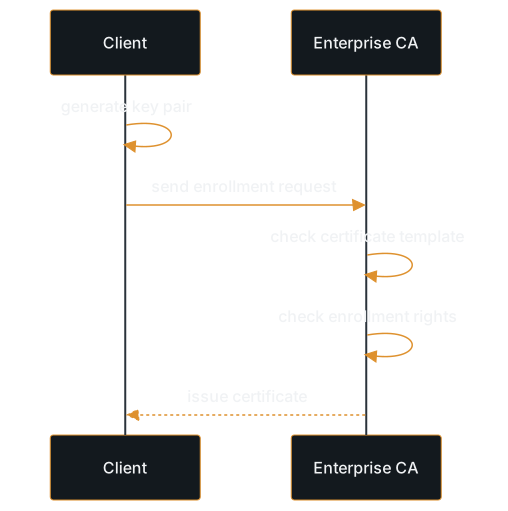
The security of this system depends entirely on who can request a passport, what identity the passport claims, and whether the passport office verifies those claims properly. If the passport office issues a document claiming you are the CEO to anyone who walks in and asks, the problem is not with the passport system; it is with the issuance policy. That is the core of AD CS risk: the certificate authority works exactly as configured, and the configuration determines whether the system is secure or exploitable.
Common misunderstandings
- AD CS is just about encrypting web traffic. AD CS certificates can authenticate users to the domain, which means they are identity credentials, not just encryption tools.
- AD CS is a default component of every AD deployment. It is an optional server role that must be explicitly installed and configured, though it is extremely common in enterprise environments.
- AD CS is the same as generic certificate management. The critical difference is that AD CS enterprise CAs are integrated with Active Directory identity, so misconfiguration has domain-wide authentication impact rather than just TLS impact.
- Securing the CA server is sufficient. The most common AD CS vulnerabilities are in certificate template configuration and enrollment permissions, not in the CA server itself.
Real-world context
AD CS is deployed in a significant percentage of enterprise Active Directory environments. Organizations use it for smart card authentication, internal web server certificates, email encryption, VPN authentication, and Wi-Fi certificate-based access. The SpecterOps research that cataloged AD CS abuse paths found that misconfigured certificate templates are among the most common and most impactful findings in Active Directory penetration tests.
In practice, many AD CS deployments were configured years ago using default or overly permissive settings and have never been audited. The combination of long-lived certificates, broad enrollment permissions, and authentication-capable templates creates an attack surface that often persists undetected through multiple security assessments, because teams that do not specifically look for AD CS misconfiguration rarely find it.
Communication
Interview answer
When asked about AD CS, the strongest answer connects certificate issuance to identity trust rather than treating it as a generic PKI topic.
AD CS is the Windows Server role that gives an organization its own internal certificate authority, integrated with Active Directory. What makes it significant from a security perspective is that certificates issued by AD CS can be used for domain authentication: they function as credentials. The main attack surface is in certificate template configuration and enrollment permissions. If a template allows a low-privilege user to request a certificate with authentication properties for any identity, that is a direct path to domain compromise.
The risk is not in the CA being hacked; it is in the CA doing exactly what it was configured to do, with a configuration that happens to be dangerous.
Follow-up questions
- What is the difference between a standalone CA and an enterprise CA in AD CS, and why does the distinction matter for security?
- If an organization rotates all user passwords after a breach, would that invalidate certificates issued by AD CS? Why or why not?
- How would you explain to a non-technical executive why their AD CS deployment needs a security audit even though it is working correctly for its intended purpose?
Next up
The opening question resolves here: a certificate becomes a domain administrator's credential when it carries properties usable for Kerberos authentication, and the certificate authority is configured to issue one without properly restricting which identity that certificate can claim. The CA does not need to be compromised. It only needs to be trusted, and misconfigured. That configuration lives in one specific place: the certificate template, and the enrollment rights attached to it. The next lesson, Certificate Templates and Enrollment Rights, opens with the question this one leaves open: what exact settings on a template turn routine PKI housekeeping into a privilege escalation path waiting for the right request?
Study Kit
Quick Reference
Test Your Understanding
Reinforce Key Concepts
Further Reading
- Active Directory Certificate Services Overview
Microsoft · Official Microsoft overview of AD CS architecture, CA hierarchy, and integration with Active Directory
- RFC 5280: Internet X.509 PKI Certificate and CRL Profile
IETF · The authoritative IETF specification for X.509 certificates: the standard that AD CS certificates conform to