FFoundationalActive Directory
NTLM Authentication
NTLM is a legacy authentication protocol that remains widely present in Active Directory environments despite known weaknesses. This lesson explains how it works, why it persists, what makes it vulnerable, and how to explain its relevance clearly in interviews and stakeholder conversations.
This lesson builds on
Hook
Every hardening guide singles out NTLM as the protocol to kill first: legacy, exposed, a liability the moment compatibility allows retiring it. The obvious reason would be that NTLM puts the password on the wire somewhere in that exchange, the way older protocols used to. It does not. NTLM guards the password exactly as tightly as Kerberos does, using a challenge-response exchange that never transmits the password or anything an attacker can reverse straight back into it. So if the password stays hidden either way, something else about NTLM has to explain why Pass the Hash, relay attacks, and credential interception all trace back to this one protocol.
Predict
If NTLM never puts the password on the wire either, what is different enough about it to make Pass the Hash and NTLM relay possible?
Why it matters
NTLM is the protocol behind some of the most common and impactful AD attacks: Pass the Hash, NTLM relay, and credential interception.
If you do not understand how NTLM works, you cannot explain why these attacks are possible or why they are difficult to eliminate. Many environments still depend on NTLM for compatibility reasons, which means you will encounter it on nearly every internal assessment. Understanding NTLM is not about learning a deprecated protocol; it is about understanding a persistent, exploitable authentication mechanism that remains embedded in production infrastructure.
Key Concepts
- Challenge-response model — the server issues a random challenge, the client computes a response using the password hash, and the DC verifies it; the password and hash are never sent directly over the wire
- Pass-through authentication — in a domain environment, the server forwards the challenge and response to the domain controller for verification because the server does not hold the password hash; the DC performs the actual comparison
- The hash is the secret — NTLM authentication depends on the NT hash of the password, not the password itself; anyone who has the hash can authenticate without knowing the original password, which is why hash extraction is so impactful
- Embedded protocol — NTLM is not a network protocol with its own port; it is embedded inside application protocols like SMB, HTTP, and LDAP, which is why it appears in many different network contexts
- NTLMv1 versus NTLMv2 — NTLMv2 uses a stronger response calculation and includes the server name in the computation, making it more resistant to certain attacks; NTLMv1 is cryptographically weaker and should be disabled but often is not
- No mutual authentication — NTLM does not verify the server's identity to the client, which is why relay attacks are possible; the client proves itself to the server, but has no way to confirm it is talking to the intended server
Theory
Core idea
NTLM is a challenge-response authentication protocol that allows a client to prove it knows a password without sending the password itself over the network. Instead of transmitting credentials, the server sends a random challenge, and the client computes a response using the challenge combined with a hash of the user's password.
The server (or domain controller) verifies the response by performing the same computation with the stored hash. NTLM is not a standalone network protocol; it is an embedded authentication mechanism that rides inside other protocols like SMB, HTTP, and LDAP. This is why NTLM authentication can appear in many different contexts across a network, from file share access to web application logins to remote management tools.
Mental model
Think of NTLM as a proof-of-knowledge test. The server asks a question (the challenge) that can only be answered correctly by someone who knows the password's hash. The client answers (the response) without revealing the hash itself. The server checks the answer by asking the domain controller, which has the actual hash on file. This is called pass-through authentication: the server does not store the password hash locally (in a domain context), so it forwards the challenge and response to the DC for verification.
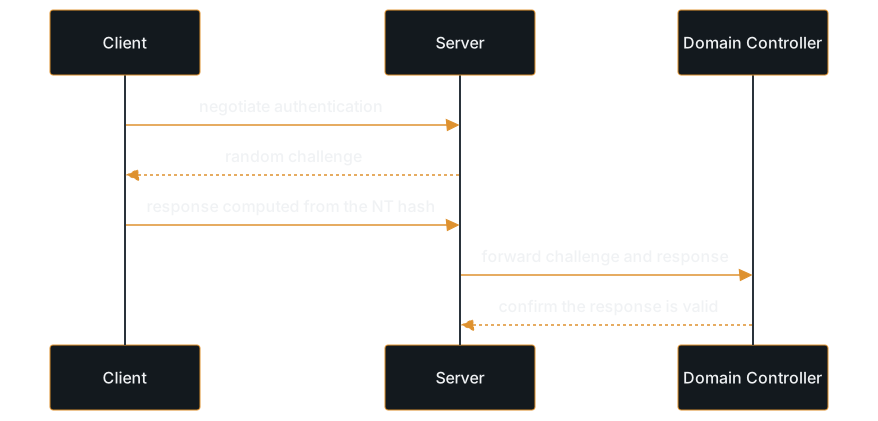
The critical security insight is that the hash itself is the secret, not the password. Anyone who possesses the hash can compute a valid response to any challenge without knowing the original password. This is the fundamental property that enables Pass the Hash attacks.
Common misunderstandings
- Believing Kerberos fully replaced NTLM. Kerberos is the preferred protocol in AD, but NTLM is still used as a fallback in many scenarios: when the client cannot reach a domain controller, when the target is identified by IP address rather than hostname, when legacy applications require it, or when Kerberos is explicitly not configured. In most real AD environments, NTLM is active alongside Kerberos.
- Thinking NTLM sends the password over the network. NTLM uses challenge-response specifically to avoid this. The password hash is used to compute the response, but neither the password nor the hash is transmitted. The vulnerability is not that NTLM sends credentials; it is that the hash alone is sufficient to authenticate, and that the protocol lacks mutual authentication.
- Assuming NTLM is only relevant on old systems. NTLM is embedded in current versions of Windows and is used by default in many common scenarios. Even fully patched, modern Windows environments typically have NTLM active. Disabling it entirely requires careful compatibility testing and is rarely done.
- Treating NTLM hashes as equivalent to passwords. An NTLM hash lets an attacker authenticate (Pass the Hash), but it does not directly reveal the password. However, the hash can be cracked offline to recover the plaintext, especially if the password is weak. The hash and the password are different assets with different implications.
Real-world context
On real assessments, you encounter NTLM constantly. When you use tools like CrackMapExec, Impacket, or Evil-WinRM with an NT hash instead of a password, you are exploiting the fact that NTLM treats the hash as the authentication secret. When you run Responder to capture Net-NTLMv2 hashes from the network, you are intercepting NTLM challenge-response exchanges. When you perform an NTLM relay attack, you are exploiting the absence of mutual authentication.
Understanding NTLM is what connects these tools and techniques into a coherent picture. When explaining findings to a client, you need to articulate why disabling NTLMv1, enforcing SMB signing, and enabling Extended Protection for Authentication matter. These are not abstract hardening steps; they are direct mitigations for the protocol weaknesses you are exploiting.
Communication
Interview answer
NTLM is a challenge-response authentication protocol that is still widely used in Active Directory environments as a fallback alongside Kerberos. The server sends a random challenge, the client computes a response using the NT hash of the user's password, and the domain controller verifies it. The password and hash are never sent over the wire directly, but the critical property is that the hash alone is sufficient to authenticate: if an attacker extracts the hash from memory or a database, they can authenticate as that user without knowing the password.
This is what makes Pass the Hash possible. NTLM also lacks mutual authentication, meaning the client cannot verify the server's identity, which is what enables relay attacks. Despite its weaknesses, NTLM persists because it is deeply embedded in Windows networking as a fallback for scenarios where Kerberos cannot be used, and fully disabling it is a significant operational challenge for most organizations.
Follow-up questions
- What is the difference between an NT hash and a Net-NTLMv2 hash, and why does it matter for an attacker?
- Why can you authenticate with just an NTLM hash without knowing the password?
- In what scenarios does NTLM get used instead of Kerberos in a modern AD environment?
- What is the relationship between NTLM's lack of mutual authentication and relay attacks?
- What hardening measures can reduce NTLM exposure, and why are they rarely fully implemented?
Next up
The opening question resolves here: NTLM never risks the password either, so its weaker reputation comes from somewhere else. Because the hash alone computes a valid response, whoever holds it authenticates without ever needing the password, and because NTLM never confirms the server's identity back to the client, that same response can be relayed to a target the user never meant to reach. Authentication only ever answers who is asking, though; what that identity is then permitted to touch is decided somewhere else entirely, and it is not always visible from group membership. The next lesson, Access Control Lists, opens with exactly that gap: a help desk account with no privileged group memberships that can still reset a Domain Admin's password.
Study Kit
Quick Reference
Test Your Understanding
Reinforce Key Concepts
Further Reading
- NTLM Overview
Microsoft · Official Microsoft reference for the NTLM authentication protocol family
- Network Security: LAN Manager Authentication Level
Microsoft · Microsoft policy reference for LAN Manager authentication levels: explains NTLMv1 vs NTLMv2 configuration and hardening